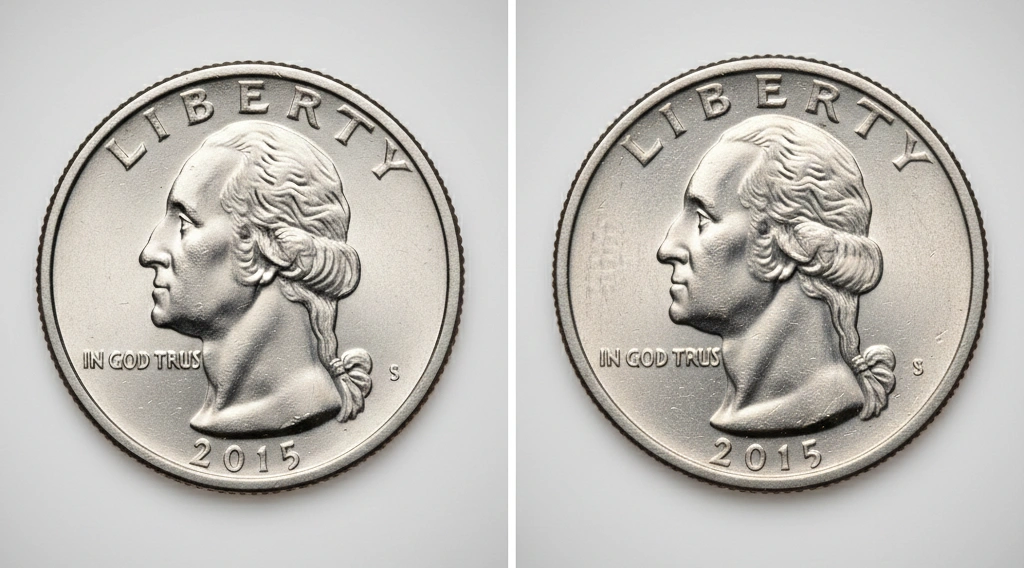
In 2015, the United States Mint released five new designs under the America the Beautiful Quarters Program, but among this huge amount, there are also the 2015 quarter errors.
Design | Philadelphia Mint (P) | Denver Mint (D) | Total Mintage (Millions) |
Homestead | 214,400,000 | 248,600,000 | 463,000,000 |
Kisatchie | 196,800,000 | 182,200,000 | 379,000,000 |
Blue Ridge Parkway | 273,000,000 | 332,800,000 | 605,800,000 |
Bombay Hook | 221,400,000 | 255,000,000 | 476,400,000 |
Saratoga | 215,800,000 | 223,000,000 | 438,800,000 |
Mint Errors by Type
Doubled Die Elements
Doubled Die Reverse (DDR) errors occur during the working die manufacturing stage.
The most significant deviations are recorded on the Homestead quarter.
The reverse of this coin features a cabin and a water pump.
Doubling appears in the window areas of the cabin and the buckets located near the well.
Specimens exhibiting prominent DDR in MS67 condition are valued by the market between 150 and 250 US dollars.
Statistics show an annual value increase of 4–6% for such coins assuming the preservation of high surface quality.
"Leaking Bucket" Die Chip
This error is classified as a "Die Chip" resulting from a damaged die.
On the Homestead quarter's reverse, excess metal deposits form between the second and third windows of the cabin and under the buckets.
In 2015, quality control at the mints allowed thousands of such specimens to pass.
The price for a coin featuring a die chip averages from 5 to 25 dollars depending on the defect size.
"Snow on the Roof" Error
On coins dedicated to Saratoga National Historical Park, a die clogging defect or die chip frequently occurs.
Excess metal accumulating on the peak of the cabin creates a visual effect of a snow layer.
The cost of these coins on the secondary market ranges from 10 to 35 dollars for specimens in Uncirculated condition.
Analysis of eBay auction listings over the last three years confirms stable demand for this specific error lacking significant price growth (fluctuations within 1–2% annually).
Error Type | Design | Record Price (Grade) | Current Market Price (AVG) |
Doubled Die Reverse | Homestead | $450 (MS68) | $45 - $120 |
Die Chip (Leaking Bucket) | Homestead | $65 (MS66) | $8 - $20 |
Die Chip (Snow on Roof) | Saratoga | $85 (MS67) | $12 - $35 |
Off-Center Strike (5%) | Kisatchie | $120 (MS64) | $75 - $100 |
Broadstruck | Blue Ridge | $150 (MS65) | $90 - $130 |
Value Dynamics
The market value of 2015 mint errors follows strict mathematical patterns.
According to data from numismatic aggregators, coins with "Off-Center Strike" errors demonstrate the highest liquidity.
Annual price increases for specimens with over 10% displacement average 8.5% for the 2018–2025 reporting period.
Conversely, minor "Die Chip" defects show a tendency toward a 3–5% annual decrease in value due to the constant discovery of new supplies in bank rolls.
Specifications of Mint Defects
Off-Center Strike
Displacement occurs following improper feeding of the planchet into the coining press.
In 2015, cases of 5–15% displacement were recorded on Kisatchie quarters.
A coin possessing over 25% displacement while retaining the date of issue constitutes the most valuable lot.
The record price for a 25% off-center 2015-D Kisatchie quarter in MS64 grade reached 215 dollars at a Heritage Auctions event.
Edge Errors
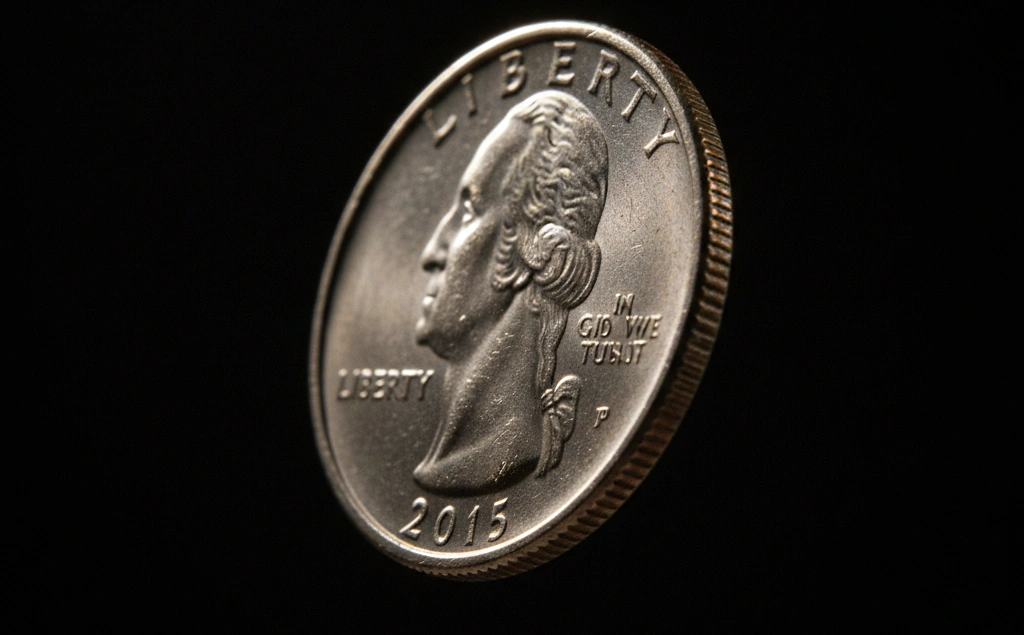
2015 quarters feature a reeded edge.
Technological failures result in coins possessing a smooth edge or partial reeding.
Such specimens occur extremely rarely, with prices starting at 100 dollars for a coin in AU (Almost Uncirculated) condition.
Defect Identification
Confirming the authenticity of an error requires using a coin value checker app.
Primary search zones on the reverse of the 2015 quarters include:
The "E PLURIBUS UNUM" inscription (possible letter doubling);
Small design elements (tools, leaves, architectural details);
Die fields near the rim (searching for die cracks).
Using specialized catalogs, such as the "Cherrypickers' Guide to Rare Die Varieties," allows for the precise correlation of a found defect with an officially recognized FS (Fivaz-Stanton) number.
Comparison of Rarity by Mint Mark
Traditionally, Philadelphia coins more frequently contain "Die Chip" errors resulting from higher equipment loads.
The Denver Mint demonstrated higher precision in 2015, making errors with the "D" mark 12–15% rarer compared to the "P" mark.
This difference is reflected in the price: the collector value of an identical error on a Denver-minted coin is typically 10–20% higher.
Conclusion
Investing in the 2015 quarters with mint errors requires an understanding of grading.
The price difference between MS65 and MS67 grades can reach 300–400%.
Statistics confirm that 85% of all transactions exceeding 100 dollars involve certified coins.
These errors can be checked with the coin identifier app and continue entering circulation from unopened bags and rolls, providing annual updates to the numismatic market with new finds.
Studying the mint technical regulations allows for predicting the appearance of certain types of defects depending on the wear of die pairs.
In the long term (5–10 years), a stabilization of prices for major DDR varieties is projected while maintaining volatility for unique production defects.